
Iraq: NATO Mission Tested by Crisis, Between Forced Withdrawal and Hopes of Return
- 21 mai
- 6 min de lecture

By Audrey Rodrigues
For a year, French General Christophe Hintzy commanded NATO’s mission in Iraq amid severe regional turbulence. Between strategic restructuring, regional war, emergency evacuation while maintaining dialogue with Baghdad, the outgoing commander defends the record of a mission he believes has become essential to Iraqi stability and Western influence in the Middle East.
Baghdad is no longer the besieged and fractured city it was at the height of the American wars and the expansion of the Islamic State group. Eight years after ISIS lost its territorial caliphate, Iraq is now looking for stabilising its institutions, strengthening its security forces and reclaiming a balancing role in a region under constant tension. It was in this context that French General Christophe Hintzy commanded the NATO Mission Iraq (NMI) from 22 May 2025 to 19 May 2026 — a non-combat advisory and assistance mission established at the request of the Iraqi government in 2018.
Comprising 750 personnel from 28 Allied and partner nations of the Atlantic Alliance, the mission aims to advise Iraq’s security institutions, strengthen their capabilities and prevent any lasting resurgence of Daesh. In the longer term, the objective is also political: anchoring Iraq in a long-term partnership with NATO in a region where balances of power remain especially fragile.
In Baghdad, the scars of decades of conflict remain visible. But the Iraqi capital also reflects a country attempting to rebuild itself. “Life in Baghdad is vibrant, restaurants are full,” the French general observes. The constant traffic jams, he says, sometimes resemble “a French summer holiday crossover weekend” — urban chaos that has paradoxically become a sign of economic recovery and a gradual return to a form of normality.
An Advisory Mission More Political Than Operational
At the opposite of the image often associated to international operations in Iraq, NMI does not directly participate in combat operations against jihadist groups. Its role is to advise the ministries of defence and interior, harmonise military training, improve command capabilities, and support crisis management and anti-corruption efforts.
The French command focused on 29 long-term objectives covering a broad range of areas: modernising officer training programs, operational simulation, force rationalisation, leadership development, digitalisation and coordination between security institutions.
From the outset of his command, Christophe Hintzy says he wanted to inject a new tempo into the mission. “We had to avoid falling into the trap of ‘we’ve always done it this way’,” he explains. Internal meetings were multiplied, processes reorganised, and several liaison offices established directly within major Iraqi headquarters to streamline day-to-day exchanges.
The mission quickly claimed to have gained an unprecedented level of trust from Iraqi military authorities.
The general points to his constant engagement with Iraqi political and military officials, while personally accompanying his advisory teams in order to facilitate certain contacts and accelerate ongoing projects.
Three months into the mandate, mission teams submitted an internal report to Iraqi authorities titled Honest Feedback, providing a critical assessment of the country’s security structures and proposing 31 recommendations. Twenty-one of them were approved by the Iraqi Chief of Staff.
For the French general, however, the main risk in such missions remains cultural misunderstanding. “You have to leave your certainties at home,” he insists. “Trying to impose a Western solution without taking Iraqi culture into account would be a mistake.”
This pragmatic approach notably translated into efforts to bridge historically compartmentalised Iraqi institutions. NMI supported joint simulation exercises aimed at improving command capabilities and coordination between the army, air defence and the Ministry of Interior.
A Contained but Persistent Jihadist Threat
The French general now assesses the threat posed by ISIS in Iraq as “limited and localised”. A handful of cells remain active in remote areas, but Iraqi forces are now believed capable of containing them without direct foreign operational support.
NATO’s mission therefore contributes indirectly to the fight against the jihadist group — not by participating in military operations, but by strengthening the structural capabilities of Iraqi security forces through officer training, command organisation, simulation exercises and improved inter-agency coordination.
Iraq nevertheless remains under intense regional security pressure, particularly because of the lingering consequences of the war in Syria and the ongoing rivalry between Iran and the United States on Iraqi soil.
According to Christophe Hintzy, the main threat to Iraq’s stability today no longer primarily stems from ISIS, but from the proliferation of weapons and the influence of certain armed militias. “The Iraqis want to avoid civil war and internal destabilisation at all costs,” he stresses.
The general says he witnessed this evolution firsthand during visits to Basra, Najaf, Karbala, Ramadi-Fallujah and Kirkush, northeast of Baghdad. “I never once felt in danger during my mission,” he states, while acknowledging the enduring weight of Western perceptions associated with Iraq.
The Shock of Regional Crises
General Hintzy’s tenure was nevertheless marked by a succession of major crises. Three weeks after taking command, the region was shaken by the “Twelve-Day War” of June 2025.
At the same time, Operation Inherent Resolve — the US-led international coalition mission against ISIS — began a major restructuring and gradually withdrew from Baghdad in autumn 2025, redeploying towards Iraqi Kurdistan.
The American departure profoundly altered the logistical and security balance at Union 3 camp, previously shared with US forces. From 1 October onward, NATO assumed full responsibility for the site. The French general then found himself simultaneously commanding the mission’s 750 personnel as well as around 500 civilian contractors present on the base.
Meanwhile, the United Nations ended the mandate of its political mission in Iraq, UNAMI, while the European Union Advisory Mission (EUAM) continued its cooperation with Baghdad, particularly on crisis management and anti-corruption issues.
For NATO, this gradual reconfiguration of international presences further reinforced NMI’s strategic importance in a country that has become one of the Middle East’s principal arenas of influence competition.
The Evacuation of March 2026
The most critical phase came between February and March 2026. Located in immediate proximity to the US embassy in Baghdad — regularly targeted by rocket fire and Shahed drones — Union 3 camp entered a zone of heightened risk.
On 13 March, NATO ordered the evacuation of the 1,300 people present at the camp.
“An evacuation operation is an extremely sensitive military mission,” Christophe Hintzy recalls. Supported by US CENTCOM, NATO AIRCOM and the Joint Force Command Naples, the operation was carried out in two rotations on 18 and 20 March.
The general does not hide the frustration caused by the decision. “For soldiers, devotion to the mission is sacred,” he confides. “My mission that day was to evacuate everyone safely.”
The departure from Baghdad clearly remains one of the defining moments of his tenure. He still remembers the torrential rain that fell on the day of the final withdrawal. “As I was leaving the camp, I thought that even Iraq was crying over our departure,” he recalls.
A Mission Continued Remotely from Naples
Following the evacuation, a reduced cell of 65 personnel was re-established in Naples to maintain advisory activities remotely through videoconferencing.
A solution the general admits he initially viewed with scepticism. “The idea of remote advising — especially for an Arab country — may seem unusual,” he acknowledges.
Yet exchanges with Iraqi authorities continued. According to him, both the Iraqi Chief of Staff and the Minister of Interior issued explicit instructions to maintain ties with NATO.
The general sees this continuity as proof of the strength of the relationships built over months. “Behind the ties established over many months between the mission and the Iraqis, there was a genuine willingness to continue working together.”
Iraq, a Strategic Issue for NATO
Beyond security concerns alone, the French general insists on Iraq’s growing geopolitical importance for Western countries.
“Strategic competition in Iraq is intense,” he states, pointing simultaneously to Iranian influence, Russian opportunism and Chinese economic engagement.
In this context, NMI represents what he describes as an essential instrument of influence for the Atlantic Alliance. “The longer our absence lasts, the more strategic space opens up for our competitors,” he warns.
The outgoing commander even argues that Iraq is now one of the few countries in the region openly expressing a desire to cooperate with NATO. “Iraq likes NATO and wants more NATO,” he summarises.
Before the North Atlantic Council, the French general reportedly declared that he had “never seen such a strong relationship between a country and a mission” in thirty-seven years of service.
The Challenge of Returning
For Christophe Hintzy, the main challenge in the coming months will now be the mission’s physical return to Baghdad. “Distance comes at a high cost in terms of influence and credibility,” he believes.
The general says he proposed as early as January a gradual five-year evolution of the mission aimed at consolidating ongoing reforms while progressively transferring certain responsibilities to bilateral Western partnerships.
Discussions over NMI’s future are expected to continue during the NATO summit scheduled in Ankara on 7 and 8 July.
But for the French officer, one conviction remains: the mission cannot be reduced to a merely symbolic presence. “We must deploy a sufficient presence to generate influence,” he insists. “The real test is whether the reforms initiated under NMI’s impetus will continue without us.”
At the end of a mandate marked by crises, restructuring and regional tensions, the French general maintains one certainty: that he helped consolidate NATO’s position in Iraq at a time when the balance of the Middle East remains more uncertain than ever.
And he quotes Henri Lacordaire, a sentence that accompanied him throughout his career: “Between the past, where our memories lie, and the future, where our hopes reside, there is the present, where our duties are.”



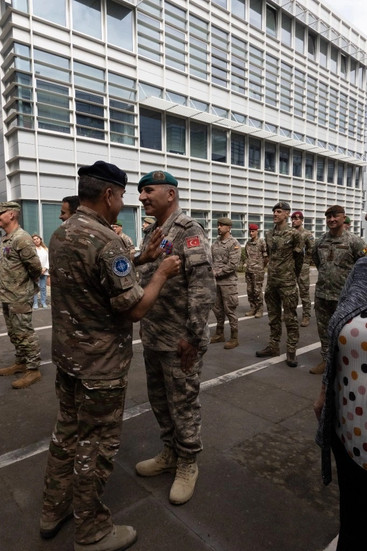


Photos : French Armed Forces General Staff - NATO


Commentaires